






















A Website Is Never Really Finished
Pratyksh Sharma
September 8, 2026
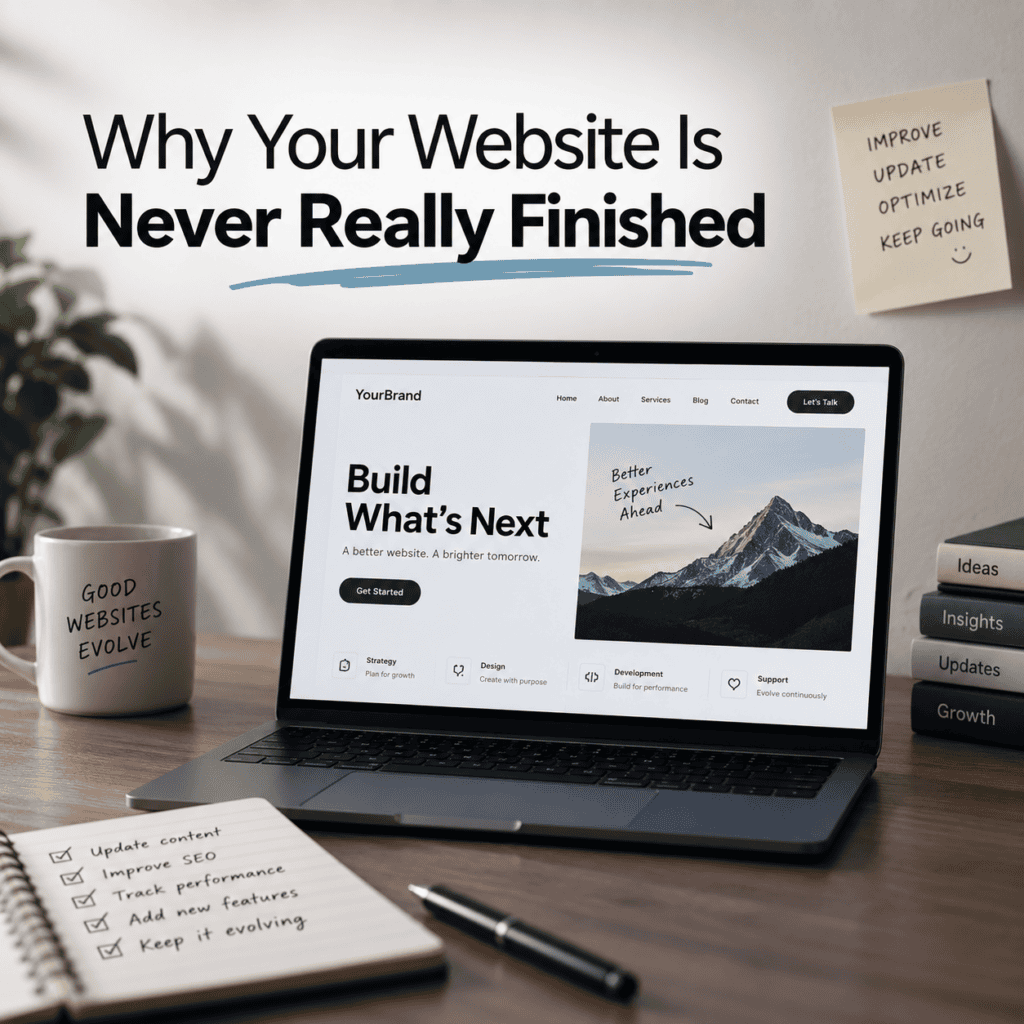
Somewhere between the invoice getting paid and the site going live, most businesses quietly file their website under “done.” It launched. It looks good. It’s been checked off the list. For the next year or two, it barely gets a second thought — until traffic starts slipping, a competitor’s site suddenly looks sharper, or someone finally notices the “our team” page still features two people who left the company a while back.
We see this pattern constantly. Not because businesses are careless, but because a website gets sold and built as a project, with a start date, an end date, and a launch. Once it’s live, it feels finished, in the same way a renovation is finished once the last coat of paint dries.
The problem is that a website doesn’t behave like a renovation. It behaves like a product. And products that stop getting attention the day they ship don’t stay good for long — they just take a while to visibly show it.
The “Done” Mindset Is the Real Problem
Think about how differently we treat other digital tools. Nobody expects an app to be “finished” after version one ships — it gets updates, fixes, improvements, new features, based on how people actually use it. A website deserves the same posture, for a simple reason: everything around it keeps moving, whether the site itself changes or not.
Search engines quietly update their ranking systems. Browsers and devices evolve. Visitor expectations shift as they get used to faster, cleaner experiences elsewhere. Your competitors update their sites. And your own business changes — new services, discontinued ones, updated pricing, a shifted target audience — often faster than the website reflects it.
A site that was genuinely well-built and fully appropriate at launch can become quietly out of step with all of that within a year or two, not because anything broke, but because everything around it moved and it didn’t.
What Keeps Changing Even If You Never Touch the Site?
This is the part that surprises people: a website can look untouched and still be losing ground, purely because the environment around it shifted.
Search algorithms evolve constantly, and pages that ranked comfortably two years ago sometimes slide simply because competitors caught up on things you haven’t revisited — page speed, content depth, structured data, mobile experience. Content ages in ways that are easy to miss internally: a services page still lists something you stopped offering, a pricing mention is out of date, a case study references a client relationship that’s ended, team photos show people who no longer work there. None of it is dramatic on its own, but collectively it starts to read as neglected to a new visitor, even if the business itself is thriving.
Software underneath the site ages too. Plugins, themes, and frameworks need updates not just for new features but for security — an unpatched vulnerability sitting quietly for a year is exactly how sites get compromised, and it rarely announces itself until it’s a problem. And expectations shift: a load time that felt acceptable a few years ago now reads as slow, because the rest of the web got faster around it.
None of this shows up as an obvious, single moment of failure. It shows up as a slow decline that’s easy to miss until someone finally asks why enquiries have quietly dropped over the last year.
The Redesign Trap
The common response, once a business notices the site has fallen behind, is to commission a full redesign every few years — essentially starting over. It’s an understandable instinct, but it’s often a more expensive and riskier fix than the situation actually calls for.
A full redesign throws out a lot along with the outdated parts. Pages that were quietly ranking well can lose their SEO value if URLs and structure change without careful redirects. Design decisions and content that were genuinely working — a particular page layout, a testimonial section, a CTA that converted well — sometimes get replaced simply because the business was tired of looking at them, not because they’d stopped performing. And a full redesign resets a lot of what you’d learned: which pages actually drove enquiries, which messaging resonated, which layout choices worked. You often end up re-testing things you already had answers for.
We’ve worked with businesses who came to us wanting “a whole new site” and, after actually digging into their analytics together, found that two or three specific pages were the real problem — not the whole site. Fixing those directly delivered results faster and at a fraction of the cost of rebuilding everything from scratch.
What Ongoing Actually Looks Like in Practice
Treating a website as an evolving product doesn’t mean constant, disruptive change. It means a steady, low-effort rhythm instead of years of silence followed by an expensive overhaul.
That can look like reviewing analytics regularly enough to notice a page’s performance sliding before it’s a crisis, rather than discovering it a year later. It looks like refreshing existing content periodically — updating a well-performing blog post with current information often does more for search performance than publishing a brand new one from scratch. It means keeping plugins, themes, and core software updated on a routine basis rather than reactively, after something breaks. It means revisiting page speed whenever new content, images, or features get added, since performance tends to degrade gradually as a site grows unless someone’s checking. And it means treating small conversion tests — a different headline, a shorter form, a repositioned call-to-action — as normal, ongoing work rather than a special project that needs its own budget approval.
None of this needs to be dramatic or constant. It needs to be regular enough that the site never has the chance to drift as far as it does when nobody’s looking for two or three years at a stretch.
Building a Site That’s Actually Built for This
Some of this comes down to how a site is built in the first place. A site that’s genuinely easy to update — a sensible content structure, a CMS the internal team can actually use without a developer for routine changes, clear documentation, analytics and tracking set up properly from day one — gets maintained. A site that requires a developer for even small text changes usually doesn’t, simply because the friction is too high, and small updates keep getting postponed until they pile up into a much bigger job.
This is worth raising with whoever builds your site, before the project starts. Ask how content gets updated after launch, who can make small changes without needing to call anyone, and what a typical update actually involves. A site engineered for ongoing change tends to age a lot better than one engineered purely to look impressive on launch day.
Someone Needs to Actually Own It
A quieter reason websites drift is that “keeping the website current” often isn’t clearly anyone’s job internally. It’s not urgent in the way a broken product or an unhappy client is urgent, so it keeps getting deprioritized in favor of things with harder deadlines — until enough time passes that it becomes a real problem.
Whether that ownership sits with someone in-house, a marketing team member, or an ongoing arrangement with whoever built the site, it helps to name it explicitly rather than assuming it’ll happen naturally. A simple, unglamorous rhythm — a quarterly look at analytics and content, routine security updates, small fixes as they’re noticed — tends to prevent almost all of the bigger, more expensive problems that come from years of neglect.
Treat It Like a Garden, Not a Monument
The businesses that get the most long-term value from their websites tend to share this mindset: the site isn’t a monument you build once and admire. It’s closer to a garden — it needs regular, modest attention to stay healthy, and neglect compounds quietly until it doesn’t anymore.
At Infyras, this is part of why we tend to push back gently when a client’s first instinct is “let’s just redesign the whole thing.” Sometimes that’s genuinely the right call. Often, though, the better return is a website that gets looked after consistently — reviewed, refreshed, and adjusted as the business and its audience actually change — rather than one that gets rebuilt from scratch every few years because nobody was tending to it in between.
Launch day was never the finish line. It’s closer to the day the actual work begins.
Let’s build your next project
Tell us about your idea and we'll get back within 24 hours.

Hi, I’m Pratyksh Sharma, the CEO and Founder of Infyras. Don’t hesitate to reach out to me anytime – I’m here to answer all your questions!
Your next idea Let’s make it happen.
From insights to inspiration, we create digital solutions that turn ideas into results. Have a project in mind? Let’s build something that moves your business forward.