
























How AI Can Help Developers During the Software Design Process
Pratyksh Sharma
September 11, 2026
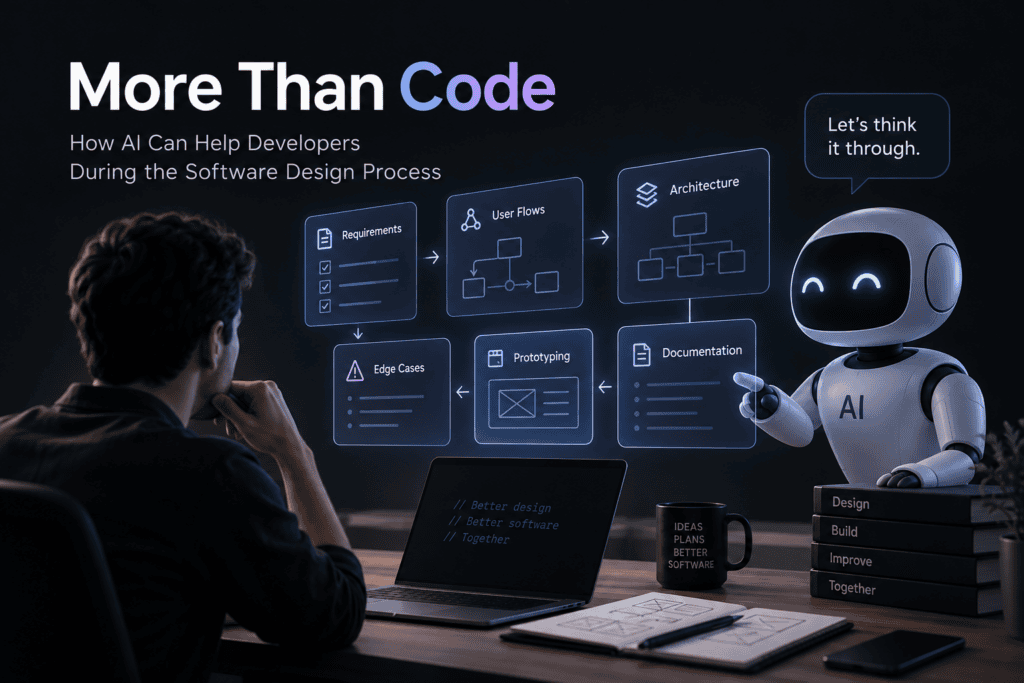
Somewhere in almost every software project, the same question comes up: should this design decision be worked out by hand, or is this a place where AI can actually speed things up? It sounds like a small choice, but it’s one of the things that most affects how clean the eventual architecture is, how much rework happens later, and how confident the team feels about the decisions once the code is actually written.
We see both extremes play out. Teams that treat AI as a rubber stamp — pasting in a vague prompt and shipping whatever comes back without questioning the assumptions baked into it. And teams that avoid it entirely, insisting that design has to be a fully manual, whiteboard-only process, even when a lot of the groundwork is exactly the kind of thing AI handles well. Neither instinct is wrong exactly — AI is a genuinely useful design partner, and human judgment is still the thing holding the whole system together. The skill is knowing which situation calls for which.
What AI Is Actually Good For
AI is at its best during design when the problem is well-understood in general but tedious to work through by hand. Sketching out multiple architectural options for a known problem, generating a first-pass data model from a set of requirements, drafting API contracts, listing edge cases a feature is likely to run into, or translating a rough idea into a structured design document — these are tasks where the pattern has been solved thousands of times before, which is exactly why a model trained on that pattern can produce a reasonable first draft faster than starting from a blank page.
The advantages are real. AI can hold a huge amount of context at once, so it’s good at cross-checking a design against constraints the developer might not be actively thinking about — this endpoint doesn’t match the naming convention used elsewhere, this schema doesn’t account for the timezone handling used in the rest of the system. It’s also genuinely useful as a sounding board: describing a design out loud, even to a model, tends to surface gaps that were invisible when the idea only existed in someone’s head. If a team needs to explore trade-offs between a few standard architectural patterns, generate scaffolding for a design doc, or get a second opinion on whether an approach has obvious holes, reaching for AI at that stage is usually the right call, not a shortcut.
Where AI Starts Working Against You
The trouble starts when AI gets used to make a decision it doesn’t actually have the context to make, or when its confident tone gets mistaken for correctness.
Over-reliance is the most common issue we see on teams new to using AI in design work. A model will produce a clean, well-formatted architecture proposal whether or not it actually understands the specific constraints of the system — the legacy database it has to talk to, the compliance requirement that shapes how data can be stored, the fact that a “simple” microservices split would blow past the team’s actual operational capacity. None of that is necessarily visible in the prompt, so the output can look authoritative while quietly being wrong for this particular system.
The bigger issue is context mismatch — asking AI to make a call that depends on organizational history, unwritten team conventions, or business priorities it was never told about. We’ve seen teams accept an AI-suggested database schema that made sense in isolation but conflicted with how three other services already expected that data to be shaped, because nobody fed the model that context up front. It technically worked as a design, but every downstream team ended up writing translation code to bridge the mismatch. A short conversation with the two other team leads would have caught it in five minutes; the AI had no way to know to ask.
There’s also a real cost to leaning on AI for decisions that need to be defensible later. If a design choice gets challenged in a review and the only answer is “that’s what it suggested,” the team hasn’t actually done the reasoning — they’ve just outsourced it, which becomes a problem the first time the suggestion turns out to be wrong.
When Human Judgment Is Genuinely the Better Investment
Human judgment earns its place when the decision depends on context that lives outside the codebase — organizational priorities, unwritten trade-offs the team has already argued through before, relationships between systems that aren’t documented anywhere a model could read them. Deciding which trade-off actually matters more for this business, negotiating a contract boundary between two teams, or deciding that a technically elegant design isn’t worth the migration cost right now — these are the situations where asking AI to weigh in usually produces something plausible-sounding rather than something actually right.
Decisions with long-term consequences are another case worth working through by hand, or at least reviewing by hand even after AI drafts a starting point. A architecture decision that will be lived with for years deserves the kind of scrutiny that comes from someone who actually understands why the last three attempts at this problem didn’t work, not just what a generically reasonable version of the solution looks like.
It’s also worth thinking about where the actual bottleneck is. Some teams have plenty of design capacity and a shortage of implementation time, in which case speeding up the design phase with AI doesn’t help much. Others spend weeks stuck in design discussions that a solid first draft would have shortened considerably — for those teams, AI earns its keep by giving the room something concrete to react to instead of starting from nothing.
A Practical Way to Actually Decide
Before defaulting to either approach, a few questions tend to make the answer obvious. Is this a well-understood problem with established patterns, or does it depend on context specific to this team and this system? Does AI actually have the relevant information — the existing conventions, the constraints, the history — or would it be filling in gaps with reasonable-sounding guesses? How consequential is this decision, and does that level of stakes justify the extra scrutiny of having a person reason through it directly rather than reviewing an output? And realistically, if the AI-generated design turns out to be wrong, would the team catch that before or after it’s built?
If the problem is common and AI has the context it needs, let it produce the first draft — there’s rarely a good reason to spend an hour manually drafting something a good prompt gets most of the way there in two minutes. If the decision depends on organizational context AI wasn’t given, or the stakes are high enough that being wrong is expensive, that’s usually a sign the reasoning needs to happen with people in the room, even if AI still helps draft the resulting document afterward.
The Middle Ground Most Teams Actually Need
In practice, the best design processes usually aren’t purely one or the other — they’re AI-assisted drafting with human judgment applied at the decision points that actually matter. A team doesn’t need to manually write out every possible architecture for a login flow from scratch; a model can lay out the standard options in minutes. What it does need is a person deciding which of those options actually fits this system, feeding the model the context it’s missing, and pressure-testing the parts of the design that carry real consequences if they’re wrong.
This approach avoids two expensive mistakes at once: spending human time re-deriving patterns that are already well understood, and quietly handing decisions to a tool that was never given enough context to make them well.
Worth Auditing How Your Team Actually Uses It
If AI has been part of your team’s design process for a while, it’s worth periodically reviewing how it’s actually being used rather than assuming the balance is right. Look for design docs where nobody can explain why a particular trade-off was made beyond “the model suggested it,” decisions that got revisited later because context was missing the first time, and places where AI is still being used just for drafting boilerplate when it could be doing more of the exploratory heavy lifting. Any of those are worth adjusting — either giving the model more context up front, or pulling a decision back into a human conversation before it goes further.
There’s No Universal Rule Here
The honest answer to “AI or manual design work” is that it depends on the specific decision, not on a blanket preference for one approach over the other. AI is the right call far more often than developers initially assume — a lot of design work is more pattern-based than it feels from the inside, and there’s no reason to spend hours manually producing something a good draft gets most of the way to. Human judgment earns its place when the decision depends on context AI doesn’t have, when the stakes are high enough to demand scrutiny, or when the reasoning behind a choice needs to be something the team can actually defend later, not just something that sounded reasonable at the time.
The goal isn’t to use AI as much as possible or as little as possible — it’s a design process that produces systems the team actually understands and can stand behind, built around where each kind of thinking genuinely adds value rather than what happened to be fastest to type into a prompt box.
Let’s build your next project
Tell us about your idea and we'll get back within 24 hours.


Hi, I’m Pratyksh Sharma, the CEO and Founder of Infyras. Don’t hesitate to reach out to me anytime – I’m here to answer all your questions!
Your next idea Let’s make it happen.
From insights to inspiration, we create digital solutions that turn ideas into results. Have a project in mind? Let’s build something that moves your business forward.