From a broken theme to a business-critical platform
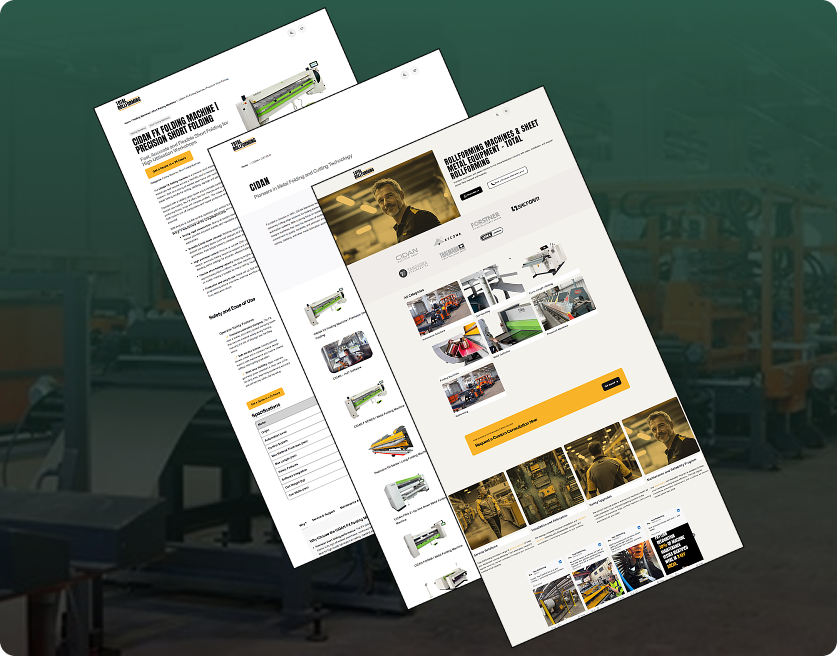
Total Rollforming supplies rollforming machinery, folding machines, coil handling equipment, and cut-to-length systems to metal fabricators across Australia and New Zealand. They also install it, relocate it, service it, and keep it running — with teams in Bowral, NSW and East Tāmaki, Auckland.
It’s a business where the machinery is the product, but the service is the relationship. That distinction shaped everything we ended up building for them.
Phase one — the website
The problem
Total Rollforming had a website that was failing on two fronts at once, and the two problems shared a single cause.
It didn’t meet the design standard. The site was built on a purchased theme assembled with Elementor. Page builders are excellent at giving non-developers freedom, and that freedom is exactly the problem at any scale — every page drifts a little further from the brand. Spacing varies. Type sizes multiply. Components get rebuilt slightly differently each time. What starts as flexibility ends as inconsistency, and for a company selling precision equipment, an imprecise website is a bad first impression.
It was slow. Themes like this ship with everything so they can serve everyone — page builder overhead, unused plugins, render-blocking CSS and JavaScript, oversized assets. A visitor loads the entire toolkit to view a single page.
For a business whose buyers are researching capital equipment purchases — often on patchy regional connections, often on mobile from a workshop floor — slow pages cost enquiries. And they cost search visibility, which costs enquiries again.
What we built
A custom WordPress theme. Purpose-built for this site rather than adapted from a general-purpose product. Only the code the site actually needs, which is the simplest and most durable performance improvement available.
ACF Pro flexible content modules. This is the part that solved the design problem properly rather than papering over it.
Instead of a blank canvas, we built Total Rollforming a library of pre-designed page modules — hero sections, machinery specification blocks, service panels, gallery layouts, calls to action. Their team assembles pages by stacking and reordering these modules and filling in the content.
The distinction matters: a page builder lets you build anything, which means it lets you build anything wrong. Flexible content modules let you build a lot — but everything you build is on-brand, responsive, and fast by default, because the design decisions were made once, in code, rather than re-made on every page by whoever is editing that day.
Their marketing team kept the autonomy they had with Elementor. They just can’t accidentally break the design any more.
Performance work throughout. Clean markup, optimised and correctly sized assets, deferred and minimised scripts, sensible caching. Not a plugin bolted on at the end — the speed comes from what isn’t in the build.
The outcome
- A site that holds its design standard on every page, including pages built after we handed it over
- PageSpeed improved from 16-18 seconds to 2-3 seconds
- Content team fully self-sufficient, new pages and machinery listings without developer involvement
Phase two — the operations platform
The website was the audition. The real work came after.
Once we’d delivered, Total Rollforming brought us in on something considerably more consequential: an internal platform to run their operations.
Selling industrial machinery is only the beginning of the relationship. Every machine sold becomes a machine to install, service, maintain, repair, and eventually relocate or upgrade. That generates a constant flow of information between three groups of people who are rarely in the same place — technicians in the field, customers on their own sites, and the office coordinating both.
We built a portal for each.
Technician portal
For the people doing the physical work — on site, often on mobile, sometimes with poor connectivity. Job details, schedules, equipment history, and service records where the technician actually is, rather than back at the office in a filing cabinet.
The value is straightforward: a technician who arrives already knowing the machine’s history is a technician who fixes it on the first visit.
Job assignment, service report capture, photo upload, parts used, checklists, signatures, offline behaviour.
Customer portal
Total Rollforming’s customers own expensive equipment their production depends on. Self-service access to their machines, service history, and job status replaces a phone call and a wait — and the transparency itself is a retention feature, since a customer who can see what’s happening trusts the supplier more.
Equipment register, service history, request submission, quotes, documents and manuals, job tracking.
Admin portal
The coordination layer. Scheduling, job assignment, customer and equipment records, and oversight of everything moving through both other portals.
Dispatch, reporting, user management, invoicing or system integrations.
Why this project matters
Plenty of agencies can rebuild a WordPress site. Far fewer get asked to build the system a business actually runs on because that requires a client to trust you with something they can’t easily replace.
That trust was earned in the ordinary way: by doing phase one properly, on time, and by still being there afterwards.
The technical range matters too. The website and the portals are genuinely different disciplines one is content, design consistency, and page speed; the other is roles, permissions, workflows, data models, and mobile use in industrial conditions. Being able to do both is why the client didn’t have to go find a second vendor.
The results
- A website that meets the design standard: consistently, on every page, including ones built after handover
- PageSpeed improvement from 16-18 seconds to 2-3 seconds
- A content team that can publish independently without design drift
- Three role-specific portals running technician, customer, and admin workflows
- Operations moved out of email, phone calls, and spreadsheets into a single system
- An ongoing partnership — 1.5 year and continuing