
























WordPress, Webflow, Shopify or Custom Code: How Do You Actually Choose?
Pratyksh Sharma
September 7, 2026
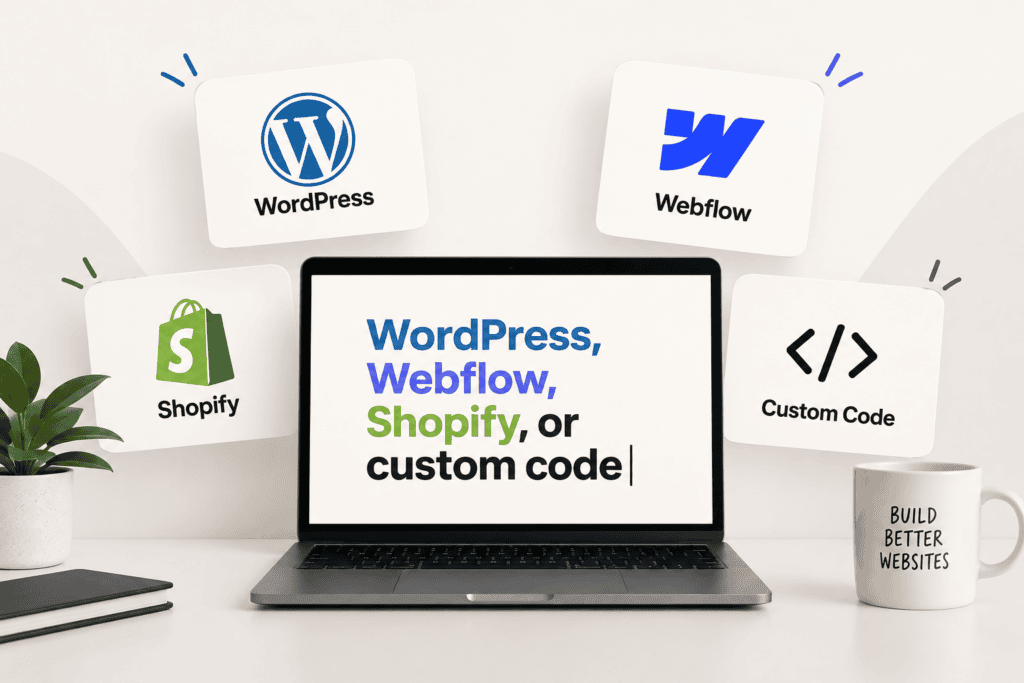
Ask five different people which platform you should build your website on, and you’ll usually get five confident, contradictory answers. A developer friend swears by WordPress. A designer you follow on Instagram insists Webflow is the only serious option left. Your cousin who runs an online store won’t hear anything except Shopify. And somewhere in the mix, someone tells you that all of these are compromises and you should just get something custom built.
Everyone sounds sure. Nobody’s actually wrong. They’re just each describing the platform that solved their specific problem, and assuming it’ll solve yours too.
It usually won’t — not because any of these platforms are bad, but because they’re built to be good at different things. The useful question was never “which platform is best.” It’s “which one fits what this business actually needs to do, who’s going to run it day to day, and where it needs to be in two years.” Once you’re asking that question instead, the decision gets a lot less confusing.
What WordPress Is Actually Built For
WordPress powers a huge share of the web, and that scale is both its biggest strength and the reason it gets a mixed reputation. At its core, WordPress is a content management system — it was built to make publishing and organizing content easy, and everything else got layered on top of that over the years through plugins and themes.
That makes it a strong fit for businesses where content is doing real work: blogs, resource libraries, service businesses that rank on search terms, membership sites, multi-author publications. It’s also genuinely flexible — with WooCommerce added, it handles e-commerce respectably; with the right plugins, it can support bookings, directories, or custom post types for almost any kind of structured content.
The trade-off is that flexibility comes with more moving parts. A WordPress site is only as secure and fast as its plugins, theme, and hosting are maintained, and a site with fifteen loosely-chosen plugins can genuinely become slow and fragile. We’ve inherited more than one WordPress site that technically “worked” but had accumulated years of plugin conflicts nobody had cleaned up. Built and maintained properly, though, WordPress remains one of the most capable, cost-effective platforms available for content-driven businesses.
What Webflow Is Actually Built For
Webflow occupies a different niche. It’s a visual, no-code (or low-code) builder that gives designers genuinely precise control over layout, animation, and interaction without writing raw HTML and CSS by hand. For marketing sites, landing pages, and portfolios where design polish and fast iteration matter more than deep content infrastructure, it’s an excellent fit.
Startups and small teams often like Webflow because a designer can build and adjust the site directly, without waiting on a developer for every small change, and because the output tends to be clean and fast without much manual optimization. It’s a strong choice for a business whose site is primarily a well-designed front door — explaining what you do, building credibility, and directing people to contact or book.
Where Webflow gets stretched thin is content scale and complex functionality. A blog with a handful of posts is fine. A resource library with hundreds of articles, complex filtering, or a large product catalog starts to push against its content management limits. It’s also a closed ecosystem — deep custom functionality or specific integrations sometimes require workarounds that a fully custom build wouldn’t need.
What Shopify Is Actually Built For
Shopify exists to sell things online, and it’s very good at that one job. Checkout, payment processing, inventory, shipping calculations, tax handling, abandoned cart recovery — the commerce infrastructure that would take significant development time to build from scratch comes ready to go, tested at a scale most individual businesses could never justify building themselves.
If the core of your business is a product catalog — physical goods, digital downloads, subscriptions — Shopify removes a lot of the risk and cost of building commerce functionality yourself. It’s why we recommend it often for straightforward retail and D2C businesses where the website’s main job is genuinely to sell.
The trade-off shows up when content and commerce need to work closely together, or when a business’s needs go beyond what Shopify’s app ecosystem comfortably supports. A retailer who also wants a serious content and SEO strategy — long-form guides, extensive blogging, complex non-product pages — sometimes finds WooCommerce on WordPress a better fit, since content is the native strength there and commerce is the add-on, rather than the other way around. Highly specific checkout logic, unusual pricing structures, or deep ERP integrations can also push a Shopify build toward needing significant custom app development anyway.
When Custom Code Is the Right Call
Custom development means building the site’s functionality from scratch rather than starting from an existing platform’s foundation. It’s the most expensive and time-intensive option upfront, and for a lot of businesses, genuinely unnecessary — a well-built WordPress, Webflow, or Shopify site will outperform an over-engineered custom build most of the time.
Custom code earns its cost when a business’s core functionality doesn’t map cleanly onto what any existing platform offers. A logistics company with a real-time quoting engine tied to live shipping data. A marketplace connecting two different types of users with different permissions and workflows. A SaaS product where the “website” is really an application. A business with performance requirements or a scale of traffic where platform overhead starts to matter.
We built a custom quoting and scheduling system for a client whose pricing depended on a combination of variables — location, volume, timing, service tier — that no off-the-shelf booking plugin handled correctly without extensive, fragile workarounds. Attempting to force that logic into a page builder would have cost more in workarounds than building it properly from the start. That’s the situation where custom code stops being overkill and starts being the only real option.
The Questions That Actually Decide This For You
Instead of starting from “which platform,” it helps to start from a short set of questions about the business itself.
What is the website’s core job — is it primarily about content and authority, primarily about selling products, primarily a polished front door for a service business, or does it need to run actual custom business logic? Who manages it day to day, and how comfortable are they with technical tools — will a non-technical team member need to add pages, write blog posts, or update products regularly? How much is the business likely to grow or change in the next couple of years — more products, more content, new integrations, a jump in traffic? What does it need to connect to — a CRM, an inventory system, a booking tool, a payment processor with specific requirements? And realistically, what’s the budget, not just for the initial build, but for the ongoing maintenance, hosting, and inevitable future changes?
Answering these honestly usually narrows the field on its own, often down to one obvious front-runner, before you’ve even started comparing quotes.
Where Businesses Usually Get This Wrong
A few patterns come up often enough to be worth naming directly.
Choosing a platform because a competitor uses it, without checking whether the underlying needs actually match. Picking based on upfront price alone, without factoring in what the platform will cost to run and maintain over the next few years. Assuming Shopify is the only real option for selling online, when a content-heavy business might be better served by WooCommerce, or assuming WordPress is automatically the “cheap and easy” choice, when a poorly maintained WordPress site can end up costing more in fixes than a cleaner platform would have. And underestimating how hard — and expensive — it can be to migrate later if the platform turns out to be the wrong fit, which makes it worth spending real time on this decision upfront rather than treating it as a minor detail.
None of these mistakes come from bad judgment. They come from evaluating platforms in the abstract instead of against the specific business in front of you.
You Don’t Always Have to Pick Just One
It’s also worth knowing that these aren’t always mutually exclusive choices. Plenty of solid setups combine platforms deliberately — a Webflow marketing site sitting in front of a Shopify store, a WordPress content hub feeding traffic into a separate, custom-built application, or a WooCommerce store handling both commerce and content because the business genuinely needs both to carry equal weight. The right architecture sometimes isn’t one platform doing everything, but the right platform doing each specific job well.
Bringing It Together
There’s no universally correct answer here, and any agency that tells you there is one is usually just recommending whatever they’re most comfortable building. At Infyras, we work across WordPress and WooCommerce, Shopify, and fully custom builds, specifically because the right platform genuinely changes from one business to the next, and we’d rather steer a client toward the right fit than toward our own convenience.
If you’re stuck between two or three of these options, the fastest way through it usually isn’t more research — it’s getting specific about what the site actually needs to do, who’s running it, and where the business is headed, and then matching the platform to that, rather than the other way around.
Let’s build your next project
Tell us about your idea and we'll get back within 24 hours.

Hi, I’m Pratyksh Sharma, the CEO and Founder of Infyras. Don’t hesitate to reach out to me anytime – I’m here to answer all your questions!
Your next idea Let’s make it happen.
From insights to inspiration, we create digital solutions that turn ideas into results. Have a project in mind? Let’s build something that moves your business forward.