














What Makes Software Easy to Maintain?
Every business owner remembers the launch. Fewer remember what comes next. Launch day is the cheapest part of a software project’s life. Most of the... Continue reading
Pratyksh Sharma
October 19, 2026
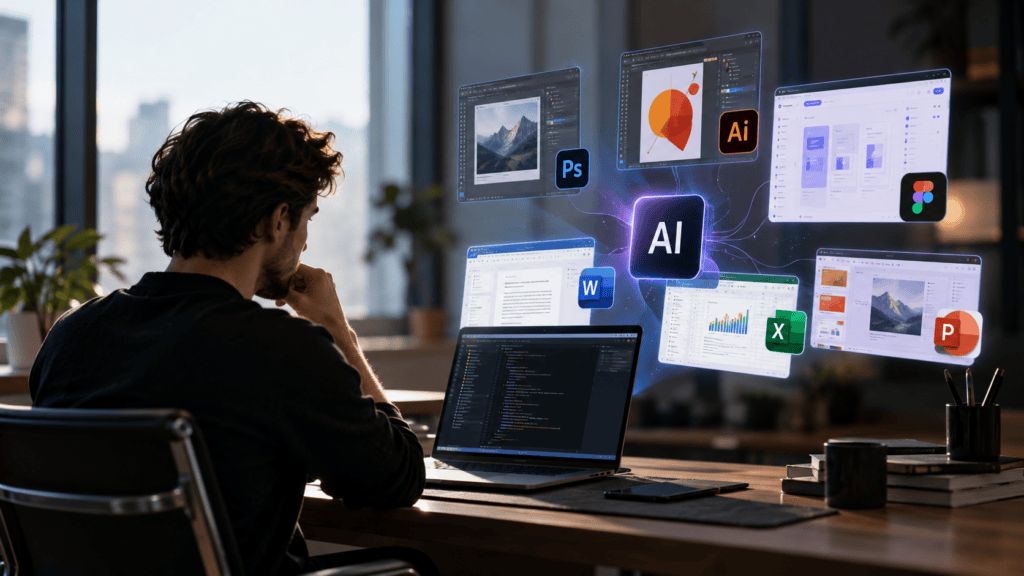
In early October 2026, a single developer released free, open-source alternatives to seven Adobe Creative Cloud apps. A few days later, the same studio shipped a Figma-style design tool. Headlines started asking whether “software is over.”
It isn’t. But something real has changed: the cost of building a credible first version of complex software has collapsed. That matters to every business that pays for SaaS, and to every team that builds software for a living.
Brandon Thomas, founder of the ArtCraft studio, published seven open-source apps written in Rust that mirror Photoshop, Illustrator, Premiere, Lightroom, After Effects, InDesign and Acrobat Pro. He says he built them with help from Anthropic’s Claude Opus 5.5, with browser versions running on WebAssembly.
The response was huge. Within eight days the repositories had passed 42,000 GitHub stars combined, with PhotoCraft, the Photoshop-style app, alone above 23,000.
Then came FigCraft, an interface design and prototyping tool modelled on Figma. Its repository went live on 9 October 2026. It offers auto layout, components, variants, prototyping and an MCP server so AI agents can drive the app. It opens Figma’s .fig files on a “best effort” basis only, and the project labels itself early alpha.
One precision matters here. None of these projects is proof that Adobe’s or Figma’s source code was copied. ArtCraft describes them as clean-room reimplementations, built from public specifications and observed behaviour. They are alternatives that look and work similarly, not copies of the originals.
They are also unfinished. Thomas first promised full Adobe parity within a month, then walked that back to “months, not years”. Early users report problems with basic functionality.
For decades, the expensive part of software was producing code. Every feature needed someone to design it, write it, test it and fix it, one line at a time. A tool like Photoshop represents thousands of person-years of that work.
AI coding agents change the arithmetic. They can now:
What ArtCraft demonstrates is not that AI writes perfect code. It’s that a small, experienced team, directing AI carefully, can reach a credible first version of a very complex product far faster than before. Thomas is a 15-year industry veteran, not a beginner typing a prompt. That detail is easy to miss and important.
The bottleneck is moving. Less of it sits in typing code; more of it sits in knowing what to build, how to structure it, and how to tell when the output is wrong.
Not yet, and probably not by rebuilding the interface alone. A familiar toolbar and layers panel is the visible 10% of a mature product. The other 90% is what professionals actually pay for:
| What users see | What years of development actually built |
|---|---|
| A familiar interface | Edge-case workflows refined by millions of users |
| File open and save | Reliable compatibility with files made by other people, other versions, other tools |
| Features on a list | Performance on huge files without crashes or data loss |
| A download link | Security reviews, updates and long-term support |
| A single app | Integrations, plugins, team permissions and admin controls |
| Working buttons | Accessibility, localisation and documentation |
FigCraft is a good illustration. It opens .fig files, but its own documentation notes the import has never been tested on real files created by others. For a design agency handing files between clients and developers, that single gap decides whether a tool is usable.
The honest answer: AI clones can quickly become “good enough” for individuals and hobbyists. Replacing the original for professional teams requires the slow, unglamorous work of reliability, compatibility and support. AI speeds that work up, but doesn’t skip it.
It depends on what is reproduced. Three things are often lumped together but are treated very differently:
The key point for businesses: using AI doesn’t automatically make a clone legal or illegal. The outcome depends on the specific facts and the law in each jurisdiction. If you’re planning a product that closely mirrors a competitor, talk to a qualified IP lawyer before you build, not after you launch.
For software companies
For developers
The role is shifting from writing every line to owning the whole system:
Developers who can direct AI well become more productive, not redundant. Those who only produce code that AI can now generate face real pressure.
Don’t cancel your subscriptions, and don’t ignore the shift either. Use it to ask a sharper question: are we paying for a tool, or for a problem being solved?
| Stick with existing SaaS when… | Explore an AI-assisted custom build when… |
|---|---|
| The tool is an industry standard your clients and partners use | You pay for many seats but use a small slice of the features |
| File compatibility and collaboration with outsiders matter | Your workflow is unique and the SaaS forces workarounds |
| You need certified security, compliance and vendor support | Several tools are stitched together with manual steps |
| The cost is small relative to the value | Subscription costs keep rising with your team size |
AI has made the first version cheap. It hasn’t made the next five years free. Before you build, budget for:
A working prototype proves an idea. A dependable production application is what you can run a business on. The gap between the two is where most of the real cost lives.
AI won’t replace developers, and it isn’t too weak to build real software. The truth sits in between: AI is changing the economics of building software, while quality, differentiation and long-term reliability still decide who wins.
At Infyras, that’s how we work. We use AI-assisted development to move faster on implementation, and we keep engineering judgment where it matters: architecture, testing, security and maintenance.
Wondering whether a custom build could replace a tool you’re paying too much for? Talk to the Infyras team and we’ll give you an honest assessment, including when sticking with SaaS is the smarter call.
Tell us about your idea and we'll get back within 24 hours.

Hi, I’m Pratyksh Sharma, the CEO and Founder of Infyras. Don’t hesitate to reach out to me anytime – I’m here to answer all your questions!
Software Design
13 October, 2026
Every business owner remembers the launch. Fewer remember what comes next. Launch day is the cheapest part of a software project’s life. Most of the... Continue reading
Software Design
11 September, 2026
Somewhere in almost every software project, the same question comes up: should this design decision be worked out by hand, or is this a place... Continue reading

Software Design
11 December, 2025
The Recent React/Next.js Attack That Shocked Developers — What Happened & How to Stay Safe (2025 Guide) Overview The JavaScript ecosystem faced a major... Continue reading
From insights to inspiration, we create digital solutions that turn ideas into results. Have a project in mind? Let’s build something that moves your business forward.