
























Why WordPress Websites Need More Than Just Updates
Most WordPress owners know the routine. A banner appears in the dashboard. Plugins need updating. You click the button, the banner disappears, and you feel... Continue reading
Pratyksh Sharma
November 12, 2026
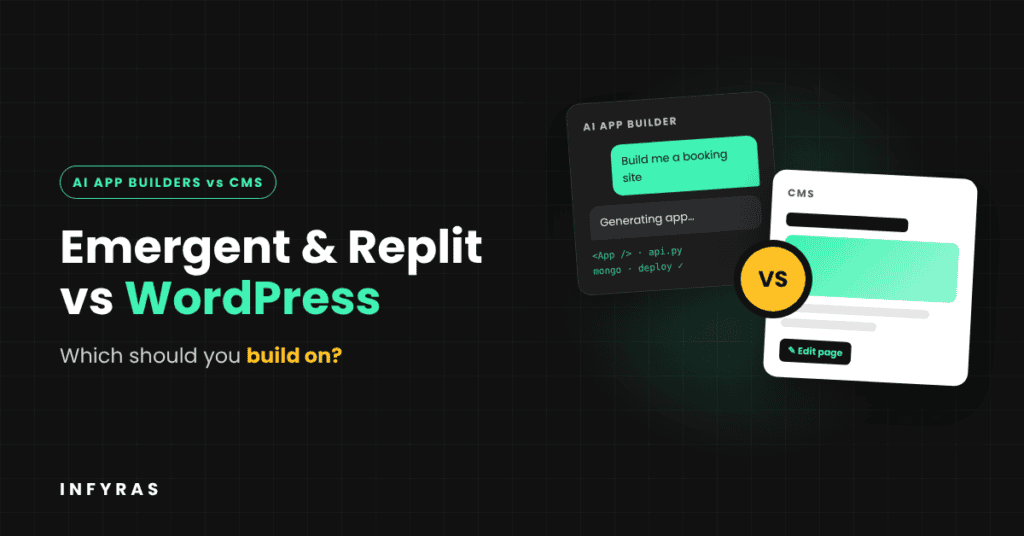
“I built my booking app in a weekend with AI. Why would I pay an agency for a website?”
We hear this more every month. AI app builders like Emergent and Replit can turn a plain-English description into a working, deployed app in hours. That is a real breakthrough, and we use AI every day at Infyras too.
But a fast first version is not the same as the right platform. In this article we compare AI app builders with WordPress, WooCommerce and Shopify, and show how we use Claude to build CMS sites almost as fast, without giving up what a CMS does best.
Both are AI app builders: you describe an app in chat, and AI agents write the code, test it and publish it.
they are excellent at producing software. A website or an online store, though, is more than software. It is a marketing channel that someone has to keep updating for years.
AI builders are at their best when the value is in custom logic behind a login, not in public pages. Emergent’s own docs list portals, CRMs, booking platforms, dashboards and SaaS MVPs among its targets (Emergent).
For these, an AI builder can genuinely save weeks. We recommend them for exactly this kind of work.
Emergent says most of its apps ship as single-page apps, where the server sends search engines “a nearly empty shell” until a setting called Enable SEO is switched on (Emergent). Even then, its docs warn that redirects and 404s reach Google as 200 OK, and that pre-rendered pages stay cached for up to 30 days. A search of Emergent’s help centre for “sitemap” returns no results.
Replit is ahead here. It runs an SEO audit after every publish, and its Agent can add a sitemap, robots.txt and meta tags when asked (Replit). But it is still a fix you have to request and re-check after every change. On WordPress, a plugin like Yoast handles it automatically as you add pages.
An AI-built site has no CMS. Changing a price, a photo or your opening hours means another prompt (and more credits) or a developer. On WordPress or Shopify, you change it yourself in two minutes.
Shopify and WooCommerce already include the cart, checkout, payment gateways, shipping, tax, discount codes, order emails and inventory. An AI builder has to generate, debug and security-test every one of these.
An independent test of one single-prompt Emergent app found 41 vulnerabilities, 7 of them High, including customers being able to view other customers’ records (Astra Security). That doesn’t mean every app is insecure, but generated code needs an expert review before it handles real customer data or payments.
Both platforms charge for AI work by usage. Building, debugging and (on Emergent) hosting all draw from the same credit balance, and Emergent’s monthly credits expire each cycle (Preuve.ai). Replit’s effort-based billing means a long debugging session costs more than a quick fix.
The real choice isn’t “slow agency vs fast AI”. It’s AI building the whole thing alone, or AI speeding up a proven platform under an expert’s eye. At Infyras we take the second route: Claude handles the repetitive work, and our developers handle the decisions.
Where Claude saves us time on a WordPress, WooCommerce or Shopify build:
What the CMS still gives you that AI builders don’t:
An AI builder wins the first build of a simple website by about 18%, then loses it within a few months. For an online store, it loses from day one. These are our planning estimates for an experienced team using AI on both sides; real projects vary.
Why the website flips: on WordPress, you make content edits yourself at no cost. On an AI builder, each edit is a prompt plus a check, about 30 minutes each, or roughly 12 hours a year.
Why the store loses outright: cart, checkout, payments, shipping, tax and order emails come ready-made on Shopify or WooCommerce. On an AI builder, they add about 30 hours of building and security testing before the first sale.
Choose by where your business value comes from: public pages that win customers, or custom logic that serves them.
If you go the AI builder route, protect yourself: export the code to GitHub, get a security review before taking real customer data, and confirm search engines can read your public pages.
AI app builders are a genuine leap for custom software. For websites and online stores, though, the fastest first build isn’t the cheapest or best result over a year. A CMS built with AI assistance and expert review gives you most of the speed, plus SEO, editability, security and freedom from lock-in.
Not sure which route fits your project? Infyras builds on WordPress, WooCommerce and Shopify, and reviews and hardens AI-built apps too. Talk to us about your project and we’ll recommend the right approach, even if it isn’t the one we build.
Tell us about your idea and we'll get back within 24 hours.


Hi, I’m Pratyksh Sharma, the CEO and Founder of Infyras. Don’t hesitate to reach out to me anytime – I’m here to answer all your questions!
Business Solution
22 October, 2026
Most WordPress owners know the routine. A banner appears in the dashboard. Plugins need updating. You click the button, the banner disappears, and you feel... Continue reading
Business Solution
01 October, 2026
“We just need a currency switcher and a translation plugin.” That’s how most multi-currency, multi-language WooCommerce projects start. It sounds like an afternoon of plugin... Continue reading

Business Solution
21 September, 2026
Accessibility tends to get introduced to business owners as a legal risk — a fine to avoid, a lawsuit to dodge, a checkbox on a... Continue reading
From insights to inspiration, we create digital solutions that turn ideas into results. Have a project in mind? Let’s build something that moves your business forward.